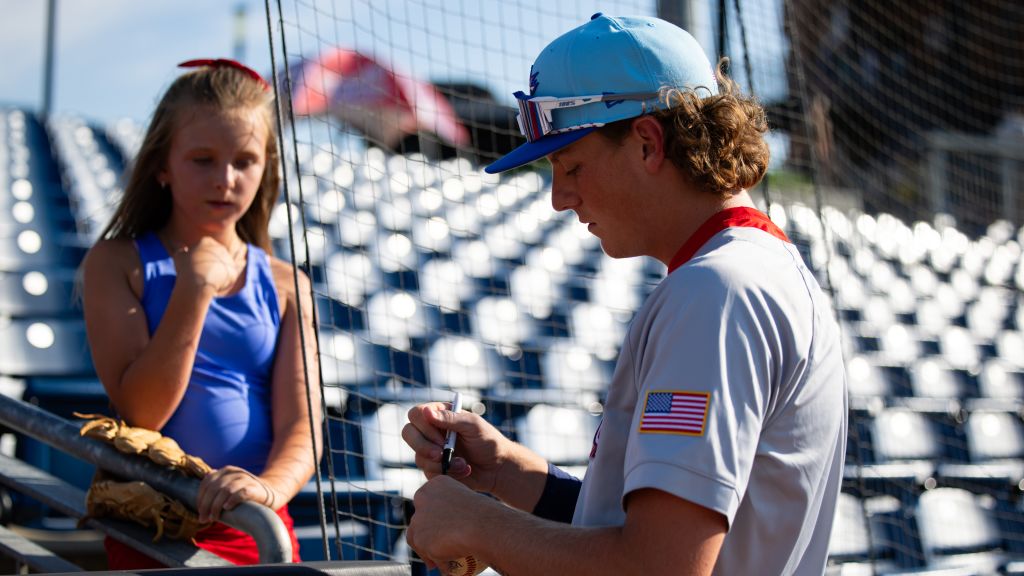
When it comes to describing the two-way greatness of Evan Dempsey, there are an infinite number of stats you could use to capture the excellence of Florida Gulf Coast’s star pitcher and slugger.
Perhaps you could point to his 2025 season, when he posted a 1.97 ERA on the mound and 19 doubles at the plate en route to winning the John Olerud Two-Way Player of the Year Award. You could bring up his Atlantic Sun Conference-leading 97 strikeouts, or his 1.016 OPS at the dish this season, which earned him a spot on the 2026 Golden Spikes Award Midseason Watch List last month. But if you ask Dempsey (who is as humble as he is dominant) about what makes him great, he will simply point to a tattoo that spells out his motto.
“Repetition is the mother of success,” it reads.
It’s a virtue that Dempsey has lived by, and played by, ever since the mentor who taught him the phrase passed away. Rich Luppino, Dempsey’s favorite coach growing up, was a local legend in the Tampa area where Dempsey was raised. After Dempsey played for him for multiple summers and helped work his baseball camps for many more, Luppino tragically passed in 2022, leaving a mark on the young ballplayer.
“He passed away when I was 16, and that was a big thing for me,” Dempsey says. “I've been playing for him since then.”
The Rise
Dempsey was born into a blended family with two brothers, two stepbrothers, and two stepsisters, in a household he describes as close-knit and competitive. After starting rec baseball when he was five years old, he joined Luppino’s travel team when he was 10 and played for him for three years. It was Luppino, he says, who fostered his love for the game and taught him the many lessons that stick with him as a player today.
Armed with a level head, the ability to spin pitches, and a knack for squaring up baseballs, Dempsey began turning heads at Newsome High School in Lithia, Florida. As a sophomore, he was already starting on the mound and in center field, and batting leadoff for the Wolves. When Florida Gulf Coast (located two hours away in Fort Myers) gave him his first offer at age 16, Dempsey jumped at the chance to continue as a two-way player for the Eagles.
“A big part of [committing to FGCU] was how they gave me an opportunity to do both,” he says. “I didn't want to give up one or the other yet, and I wanted to give myself the chance to get on the field early.”
The decision proved shrewd for Dempsey and unfortunate for the rest of the Atlantic Sun Conference. Despite a shoulder impingement that largely kept him off the mound as a freshman, Dempsey quickly made an impact for the Eagles at the plate, batting .339 with 48 RBIs and 11 stolen bases in his first season in Fort Myers. He swatted a grand slam against rival Florida International, hit a walk-off single against South Florida, and led the ASUN in triples.
Little did teams know that Dempsey had only scratched the surface of his capabilities.
Going into his sophomore year, head coach Dave Tollett asked him if he still wanted to continue pitching. His answer was an emphatic yes. Once again, the decision proved smart.
After starting the 2025 season as a reliever and joining the rotation in late March, Dempsey posted one of the best seasons of any college player last year. His 1.97 ERA was the third highest in Division I and the best among all sophomores. On offense, Dempsey batted .315 and went 14-for-14 on stolen base attempts. The performance shot Dempsey up MLB draft boards and propelled him into the national conversation. In addition to winning the John Olerud Two-Way Player of the Year Award and Consensus First-Team All-America Honors, he was invited to play in the Cape Cod League and at USA Baseball’s Collegiate National Team Training Camp last summer.
Amazingly, the success all came while Dempsey was establishing a routine on the fly. It wasn’t until injuries hit the FGCU pitching staff a month into the season that he was asked to move into the starter role, which was a difficult task with his obligations as a hitter.
“It took up until 10 weeks into the season last year to get into a real routine on the throwing and hitting side of things, so it was pretty sporadic,” he says. “I entered the year around 193 pounds and ended up losing 10 to 15 pounds.”
Realizing he needed additional strength and durability if he wanted to keep up the performance, Dempsey went to work in the offseason. After finishing his summer in the Cape, he spent weeks at home in the gym trying to put on weight. The efforts continued through the fall and the winter. In December, he posted a training montage to Instagram captioned with a familiar phrase:
"Repetition is the mother of success.”
The Return
Despite receiving a mountain of lucrative transfer offers from Power Four schools, Dempsey stayed loyal to the Eagles and chose to return to FGCU this year.
“I thought about it for maybe five minutes,” he says. “It wasn't really a tough decision.”
By the time the season rolled around, Dempsey had put on 20 pounds of muscle. Thanks to a stricter in-season diet and exercise regimen, he has been playing between 200 and 205 all year. The results have paid off, as Dempsey has somehow been even better in 2026 than he was during his record-breaking season last year.
Through 47 games and 12 starts on the mound, Dempsey leads the ASUN in strikeouts (97) and ranks fourth in ERA (3.39). At the plate, his .358 batting average is sixth best in the conference, and his 1.016 OPS is the highest of his career.
Advanced statistics paint the picture of Dempsey’s dominance even better. Per D1 Baseball, his 3.35 wins above replacement led all players in Division I at the midseason mark, and the spin rate on his slider and curveball both rank in the 99th percentile nationally. Thanks to the added weight, his average fastball velocity also improved from 89 mph last year to 92 this season, and in the box, his maximum exit velocity has increased from 106 to 109.
Perhaps the best way to capture Dempsey’s dominance as a two-way player, however, is to simply look at some of the single-game stat lines he has posted for FGCU:
- On February 20th, Dempsey pitched a complete game shutout against Stonehill, striking out seven. At the plate, he went 2-for-4 with an RBI double.
- On March 13th, he threw another complete game shutout against Queens, this time striking out 11. He went 2-for-4 again with a two-RBI double.
- Seven days later, on March 20th, Dempsey took a perfect game into the eighth inning against the ASUN’s best team, North Florida. In addition to striking out nine, he went 3-for-4 with a home run and three RBIs. The list goes on…
In all twelve of his games as the starting pitcher this year, Dempsey has recorded at least six strikeouts on the mound and one hit at the plate. He’s had five games with at least two hits and eight or more punchouts. It’s the most miraculous of all Dempsey statistical wonders, that he seems to hit even better when he’s pitching. His .444 average and 1.164 OPS in such games are both 100-point improvements from his already elite stats when playing DH or right field.
Put simply, Evan Dempsey’s 2026 season is arguably the greatest two-way year in NCAA history. With one possible exception being his 2025 season.
The Future
Still, there are doubts about whether Dempsey will continue his journey as a two-way star. Based on his talks with scouts before the season, Dempsey says they are leaning towards his future as a pitcher. That was before he put up the biggest power numbers of his career though. (He currently has 25 extra-base hits and a .574 slugging percentage.)
Dempsey himself wonders about what all he could achieve if he were to focus on one or the other.
“If I'm only hitting and I'm not exerting that extra energy, and I can play a full-time position, I maybe keep weight and strength on a little easier,” he says. “Or on the pitching side of things, if I'm not taking swings every day, do I tick up the velocity if I keep to a stricter throwing program?”
It’s a reasonable question to ask, and undoubtedly what MLB scouts are asking themselves.
One look at the previous winners of the Golden Spikes Award raises questions about the future of two-way college players in general. The five previous two-way winners — Darren Dreifort (1993), Mark Kotsay (1995), Jason Jennings (1999), A.J. Reed (2014), and Brendan McKay (2017) — all ended up on one side of the ball or the other in the MLB, either by choice or by mandate from their organizations.
But arguably none of college baseball’s recent two-way players have been quite as dominant at the plate and on the mound simultaneously. In the past 15 years, no other qualified Division I player has batted over .350 while holding opponents to an average below .210, as Dempsey has in 2026. The only player to come close was Louisville star McKay, who limited hitters to a .198 average while batting .341 in 2017. He reached the majors just two years later and was briefly allowed to play two-way by the Tampa Bay Rays before injuries forced him to focus on pitching. Dempsey could become the first two-way player to win the Golden Spikes Award and the first collegiate player to reach the pros as a two-way player since McKay achieved both feats.
Whatever he ends up doing in the pros, Dempsey is likely to be taken in the MLB Draft in July, with MLB Pipeline ranking him 91st in their latest list of top prospects. It’s simply a matter of which Evan Dempsey clubs choose — the lockdown pitcher, the power hitter with blazing speed, or both.
“What I've told them is that it doesn't really matter to me what I do at the next level,” he says. “For me, all that matters is that I get there.”
As Dempsey continues to deliver for FGCU — year after year, outing after outing, hit after hit — one can only assume that he will reach the big leagues in some form or fashion.
Repetition, after all, is the mother of success.